ONE LINE PRINCIPLE
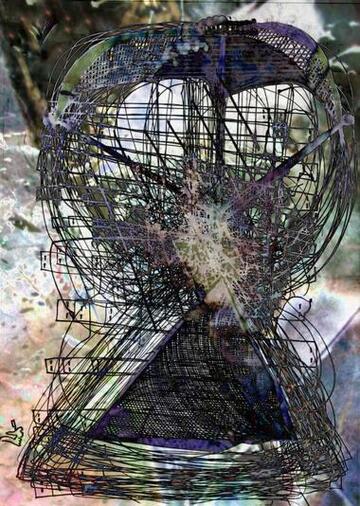
Work invariably begins with the one line. Usually a black or blue line on white paper. Other lines follow. The simplicity of one color on another color often seems to offer more chance for poetic and metaphoric expression. The lines make alliances with one another fooling the mind into this or that “known”. Such lines are felt to be in motion. The viewer's faculty of visual interpretation is challenged. From out an apparent chaos, line upstarts rear their heads and become autonomously influential often inspiring the viewer to new unexpected cognitive connections. The variable relationships that these lines forge with one another often defy the mind to “make something of them”. We see and feel the contradiction and complexity of modern life. People and things – lines - forced onto one another, unforeseeably, without logic, reason or predictable consequence. Ephemeral visions arise within us, only to be obfuscated by new constellations and oblique interpretations. The lines (individuals) here are not cogs in a pre-formed societal machinery, but rather single voices speaking freely from within the multitude where no system or process (democratic or otherwise) has intervened to coerce them to speak as a tamed, muffled, “I”. Lines, line interactions, forms and pictures are the letters, words, sentences and stories of the work – or if you like the gristle, teeth and bones of these skeleton images. The viewer is left to do the rest, to rescue the art and himself - to place the image in a (her) knowable context, to cast her vote - it's a kind of working together. Adorno notes,
“An art of a non-representational character, a language of the lifeless is the only form of comfort in a world where death has lost its meaning”
Ambiguous time - line archeology
I present the viewer with a starting point, something like an archaeological site,where once so much was, and where so much maybe still can be. The picture point is an in between phase, a limbo. The viewer makes her “dig”, discovers her artifacts and interprets. This interpretation can however in contrast to conventional archeology reconstruct not only a past, but also potential futures. The pictures are not a “what is”, but rather a “what might have been” or a “what could be”. What is seen (seeable) is a type of artistic, half way house, a snap-shot. We are on the cusp, a point from which we must spring and hopefully fly on the wings of our own metaphoric and allegoric interpretative capabilities. These mental and visual associations which one could say are up to a point, self induced emanations, are somewhat akin to the subtle, subconsciously perceived overtones produced by musical instruments. As Nietzsche mentions in “Beyond good and evil”,
“Even in the midst of the most remarkable experiences we still do the same; we fabricate the greater part of the experience, and can hardly be made to contemplate any event, except as “inventors” thereof.”

Suma Genji
Suma Genji is an experimental film written and directed by Alexis Pope. Camera and editing - Takeshi Furuya. The Tale of Genji (源氏物語 Genji) is a classic work of Japanese literature written by the noblewoman and lady-in-waiting Murasaki Shikibu in the early years of the 11th century, around the peak of the Heian period. It is sometimes called the world's first novel, the first modern novel, the first psychological novel or the first novel still to be considered a classic. Notably, the novel also illustrates a unique depiction of the livelihoods of high courtiers during the Heian period. While universally considered a masterpiece, its precise classification and influence in both Western and Eastern canon has been a matter of debate.

OUROBOROGRAPHY
Alexis Pope's art is particularly influenced by philosophers such as Adorno, Derrida and Blanchot, poets Mallarmé, Baudelaire and Rimbaud, as well as Brazilian artist Oiticica amongst myriad others. For Pope not only the title but also the contents of Monica Amor's essay, "Of adversity we Live", describes well the environment that artists still find themselves in, in the third decade of the 21st century. Deeply immersed in interdisciplinary experimental work, he has developed a hybrid system of making art which he calls ouroborography.
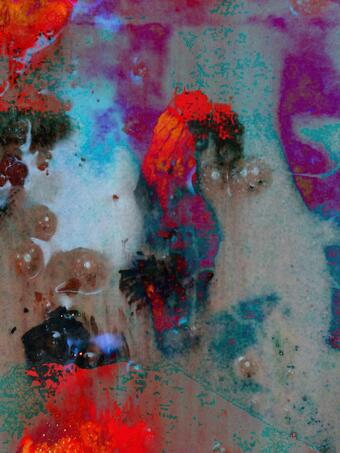
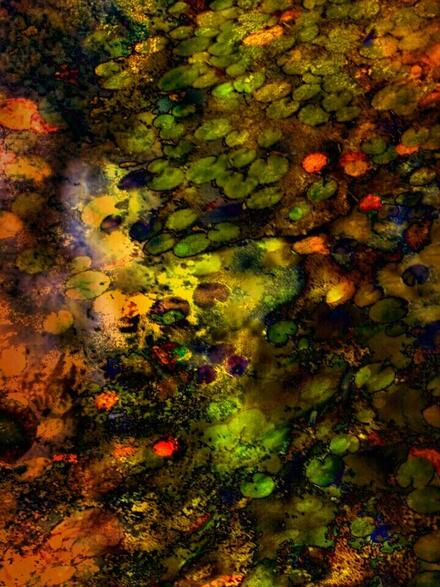
Ouroborography is the discipline of creating visual art using a camera as the symbolic instrument of writing, to record parallel multifarious artistic processes. The artist coordinates these disciplines in real time. Each successful ouroborograph contains within itself a "dramatic catharsis and a dialectical transcendence", [1] the material, expression and form of which, by the very nature of the processes involved leads to artworks of ambiguity and complexity. Jacques Derrida writes:
"however artful the photographer may be, whatever his or her intervention or style, there is a point where the photographic act is not an artistic act, a point where it passively records, and this poignant passivity would be the chance of this relation with death; it captures a reality that is there, that will have been there, in an undecomposable now.”[2]
In ouroborography, as one aspect of artistic production ceases, dies, (shutter opening or closing for example) others are continuing or immediately beginning, these transformations of emphasis are a continuous unveiling. The death of time in one discipline is heralded on the horizon of being in the other. The artist does not have Derrida's moment of passivity, the process is a continuum to “undiscover'd country from whose bourn no traveller returns”.[3] The work of the artist in this sense has much in common with the ouroboros of antiquity, which is best known as a symbol of self-reflexivity or cyclicality, especially in the sense of something constantly re-creating itself and the eternal return. Alexis T. Pope is the inventor of the ouroborograph and has been intensively experimenting with its forms and parameters.
en.wikipedia.org/wiki/User:Alexis_T._Pope/sandbox
1. Kenneth Burke, A Grammar of Motives". University of California Press
2. Deridda, Copy, Archive, Signature, Stanford University Press 2010 P.9
3. William Shakespeare, Hamlet, Act III, scene 1
"There is geometry in the humming of the strings, there is music in the spacing of the spheres." ― Pythagoras“
The deeper the feeling, the greater the pain.” ― Leonardo da Vinci
"It is true that the eyes dominate the ears in our time." ― Karlheinz Stockhausen
"The Louvre is the book in which we learn to read." ― Paul Cezanne
All rights reserved copyright © Alexis Tinsley Pope 2021
Copyright - 2022